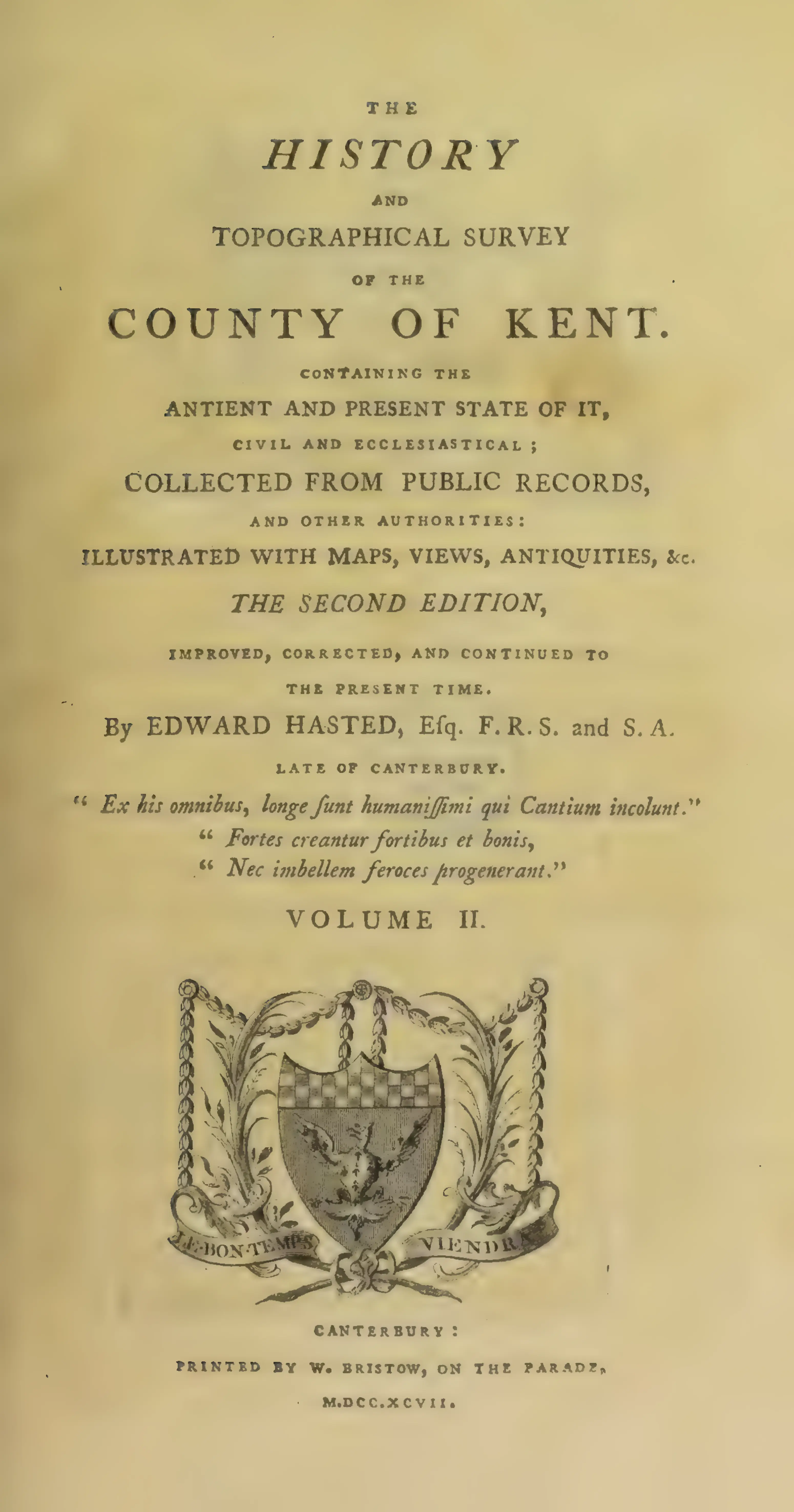
The History and Topographical Survey of the County of Kent
Edward Hasted’s survey of Kent provides the principal documented narrative of the Manor of the Dungeon from the Chiche family through Thomas Lee Warner’s demolition of the mansion in 1752.
Open document- Source type
- Published county history
- Provenance
- Edward Hasted, The History and Topographical Survey of the County of Kent, volume 11 (1800); public-domain scan preserved locally
- Evidence status
- supported
Edward Hasted (1732-1812) compiled the most detailed historical survey of Kent yet attempted. Published in four volumes between 1778 and 1799, with a second edition in twelve volumes from 1797 to 1801, it remains indispensable for the manorial, ecclesiastical, and topographical history of the county.
The Manor of the Dungeon in Hasted
Hasted’s entry for Canterbury, in Volume 11 of the second edition, provides the most complete antiquarian narrative of the Manor of the Dungeon available in print. The descent he traces runs as follows:
The Chiche family held the manor from at least Henry II’s reign. Ernaldus de Chich was prominent through Henry II, Richard I, and John. Thomas Chiche was bailiff of Canterbury in 1259 and 1271 and a benefactor to St. Mary Bredin. A John Chiche was lord in 1320, when a sentence established the hospital of St. Laurence’s entitlement to tithes. John Chich was bailiff in 1349 and
- Thomas Chich, son of John, served as sheriff of Kent under Richard II and kept his shrievalty at the Dungeon. Thomas’s great-grandson Valentine Chich died without male issue and alienated the manor around 1461 to Roger Brent, who died possessed of it in 1486 and ordered its sale.
John Boteler or Butler of Heronden in Eastry became proprietor at the beginning of Henry VIII’s reign and sold it to Sir John Hales, Chief Baron of the Exchequer. The estate descended through the Hales family to Sir James Hales of the Dungeon, who died in 1665 leaving one daughter, Elizabeth. She carried the manor to the Sheldon family, whose heirs alienated it in 1680 to Henry Lee, esquire. Henry Lee’s descendant Thomas Lee Warner demolished the mansion in 1752, leaving only outbuildings and garden walls. The property was known by this period as Donjon, alias the Coventryhouse, from Lady Coventry having resided there. Thomas Lee Warner died in 1768 and was succeeded by Henry Lee Warner of Walsingham Abbey, Norfolk.
Source Details
Hasted, Edward. “Canterbury: Manors.” The History and Topographical Survey of the County of Kent: Volume 11. Canterbury, 1800. Available through British History Online at british-history.ac.uk. Public domain.