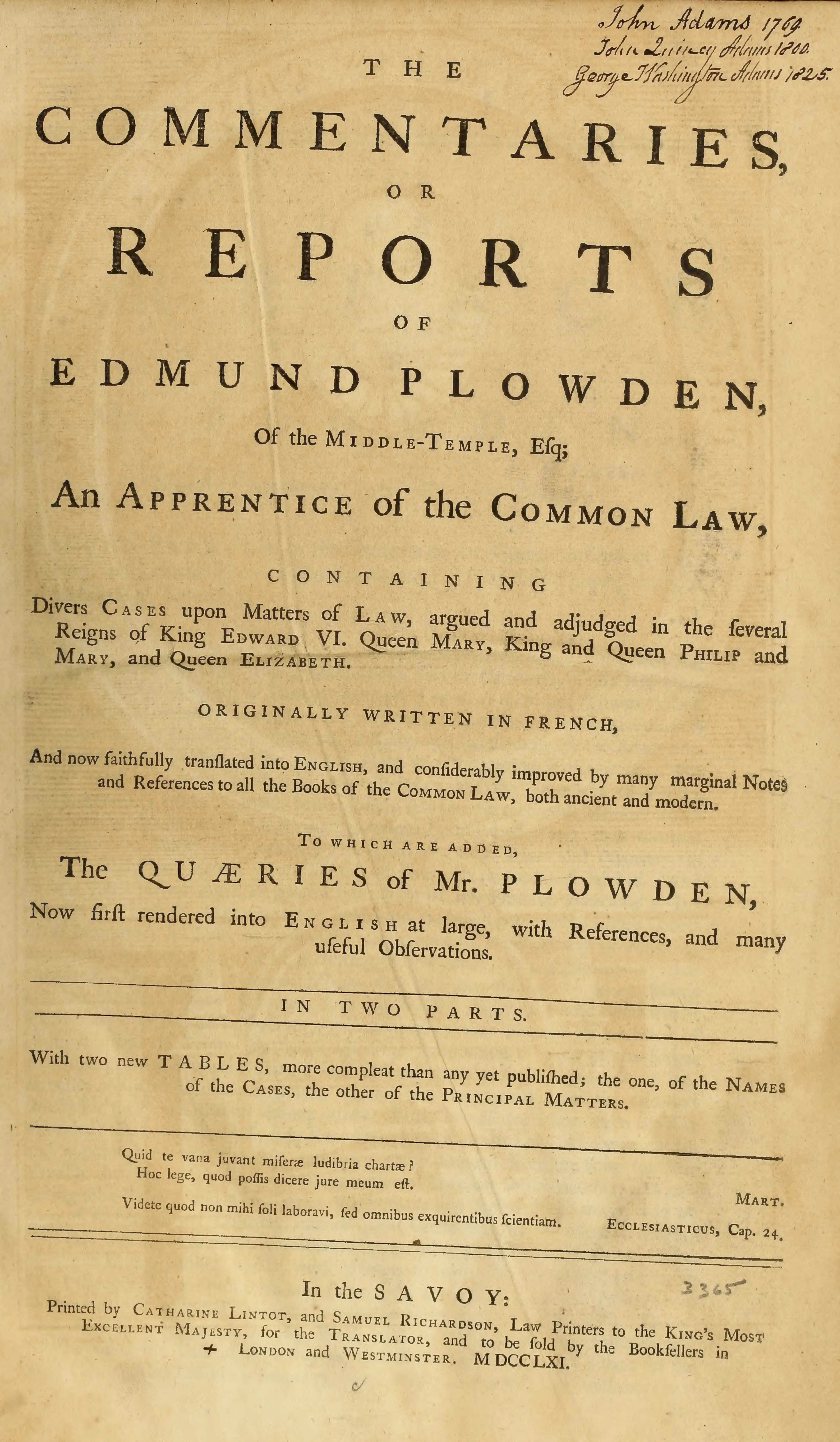
Plowden's Commentaries
Edmund Plowden’s celebrated law reports, containing the full report of Hales v. Petit (1 Plowd. 253), the landmark case arising from the death of Sir James Hales at the Dungeon and identified as a source for the gravediggers’ scene in Shakespeare’s Hamlet.
Open document- Source type
- Published law report
- Provenance
- Edmund Plowden's 1571 report of Hales v. Petit (1 Plowd. 253); public-domain scan preserved locally
- Evidence status
- established
Edmund Plowden (1518-1585) was an English barrister of the Middle Temple who compiled the most celebrated set of English law reports of the sixteenth century. His Commentaries, published in 1571, covered cases from the reigns of Edward VI and Mary I. Plowden attended the arguments he reported in person, recording them in Law French with a precision that set a new standard for English legal reporting.
Hales v. Petit
The report of Hales v. Petit appears at 1 Plowd. 253. The case arose from the death of Sir James Hales, lord of the Manor of the Dungeon, who drowned himself in August 1554 following imprisonment under Mary I. The Crown sought to forfeit his estate as felo de se. The court found that entering the water with felonious intent constituted the completed felonious act, while the death was merely its consequence. The estate was held forfeit.
The three-branch argument recorded in Plowden’s report was well known in Elizabethan legal circles, and Shakespeare drew on it in the gravediggers’ scene of Hamlet (c. 1600-1601). The connection between the case and the scene is well established in the scholarly literature.
Plowden was himself a Catholic who maintained his legal practice through Protestant reigns. The case he is most remembered for involves a Protestant judge who died under a Catholic queen — a sharp Tudor irony that belongs to the commentator rather than to any documented contemporary reaction.
Source Details
Plowden, Edmund. Commentaries. London, 1571. 1 Plowd. 253. Public domain. Available through HeinOnline and the Internet Archive.