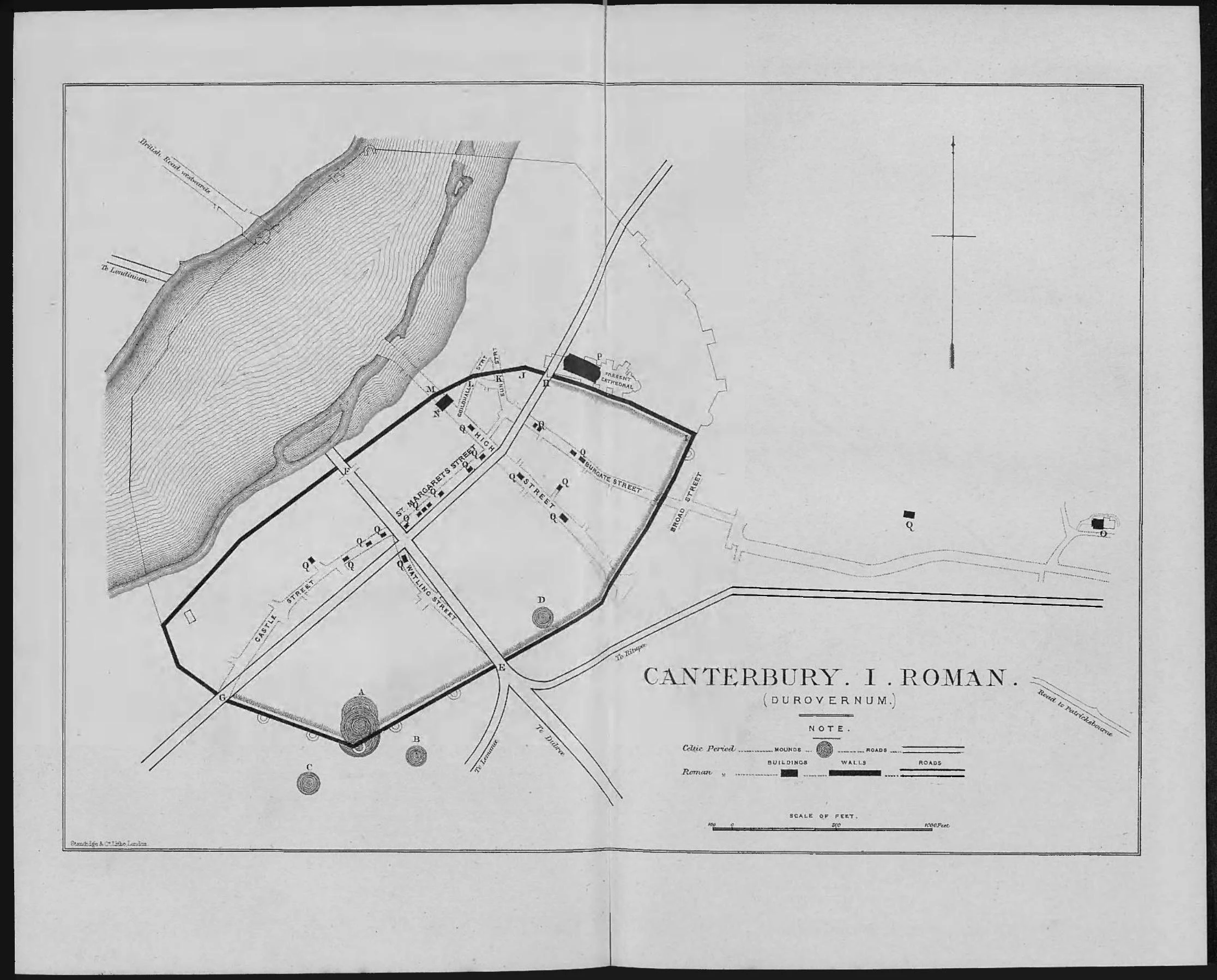
Canterbury I. Roman (Durovernum)
Fold-out plan of Roman Canterbury (Durovernum Cantiacorum) from Godfrey-Faussett’s 1875 paper, showing what he classified as Celtic and Roman features, with the Dane John mound at point A. A nineteenth-century antiquarian reconstruction.
Open document- Source type
- Antiquarian reconstruction
- Provenance
- Fold-out plate from T. G. Godfrey-Faussett's Canterbury Till Domesday (1875)
- Evidence status
- supported
This plan of Canterbury in the Roman period accompanies T. G. Godfrey-Faussett’s 1875 paper “Canterbury Till Domesday,” published in the Archaeological Journal. It represents a nineteenth-century antiquarian reconstruction of Durovernum Cantiacorum, the Roman city established at the crossing of the River Stour. Some of its interpretations, particularly the classification of the mounds as Celtic rather than Romano-British, should be read in light of later archaeological work: Historic England currently describes the Dane John mound as part of a Romano-British barrow cemetery, while Heritage Gateway notes possible Bronze Age associations suggested by a socketed axe found in a companion mound.
Reading the Map
The map uses a key that Godfrey-Faussett distinguishes as Celtic and Roman. Features he classified as Celtic include the mounds shown with concentric rings. The principal mound, labeled A, is the Dane John or Dungeon Hill, standing within the Roman city walls. Mound B (smaller, outside the walls), mound C (destroyed by railway construction before 1875), and the rumored mound D (near the cattle market) are also shown. Roman features include buildings (solid black), walls (heavy dashed lines), and roads (double lines).
Notable labeled points include: E (Riding Gate), F (gate at Beer-cart Lane), G (Worth Gate), H (Roman North Gate), P (the church later restored by Augustine as the Cathedral).
Significance
A central piece of Godfrey-Faussett’s argument was that the Roman city walls bent on the southeastern side to accommodate the position of the Dane John mound rather than cutting through it, suggesting the mound predated the walls. This spatial relationship is clearly visible on the map.
Source
Godfrey-Faussett, T. G. “Canterbury Till Domesday.” Archaeological Journal 32, no. 1 (1875): 369-393. Public domain.