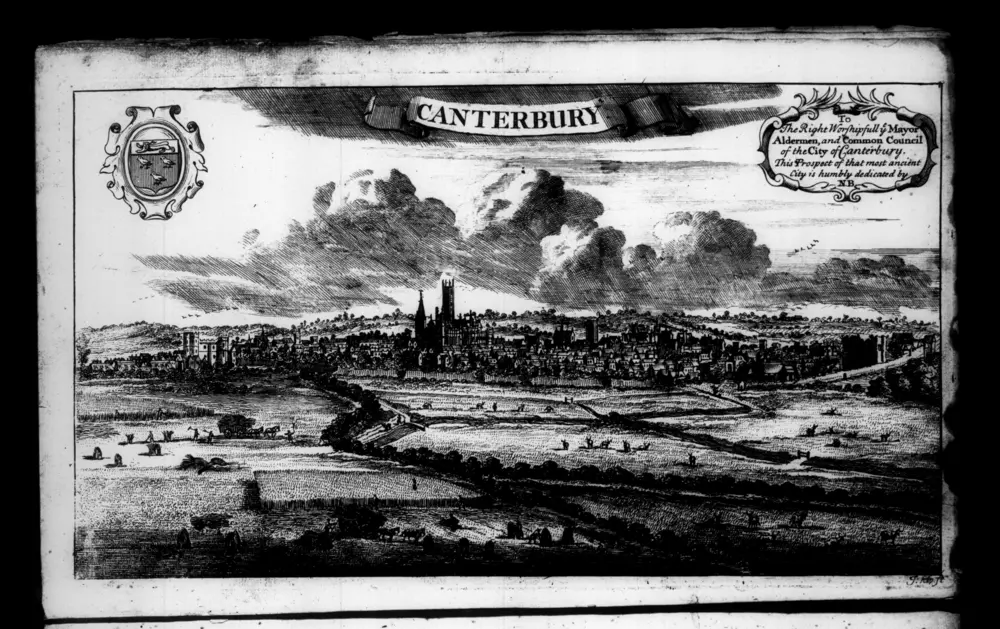
The Antiquities of Canterbury
William Somner’s 1640 survey of Canterbury, the first systematic antiquarian study of the city, and the 1703 Battely edition that remains the standard scholarly reference, both drawn on by Godfrey-Faussett in his analysis of the Dane John mounds.
Open document- Source type
- Published antiquarian history
- Provenance
- William Somner, The Antiquities of Canterbury (1640); second edition revised and enlarged by Nicholas Battely (1703); public-domain scan via Internet Archive
- Evidence status
- supported
- Reuse
- Public domain
William Somner (1598-1669) was a Canterbury-born scholar who served as Registrar of the Ecclesiastical Court of Canterbury. His Antiquities of Canterbury, first published in 1640, was the first systematic scholarly treatment of the city’s Roman, Saxon, and medieval history and remained the foundation of Canterbury antiquarianism for more than two centuries. A second edition prepared by Nicholas Battely was published in 1703 and is the standard scholarly reference.
Significance for the Dungeon
Godfrey-Faussett drew on Somner and Battely when tracing the history of the Dane John mounds in his 1875 paper. He noted that the plan of Canterbury in Somner’s 1640 edition depicted the mounds in a conventionalized manner, and that the Battely edition preserved valuable material on the city’s topographic and nomenclatural history. Later writers on the etymology of “Dane John” and its relationship to the Norman French donjon also drew on Somner and Battely as foundational references.
Source Details
Somner, William. The Antiquities of Canterbury. London, 1640. Second edition edited by Nicholas Battely. London, 1703. Both editions are in the public domain. The document link above opens the Internet Archive scan of the revised and enlarged 1703 edition; the archive image is taken from that edition’s engraved prospect of Canterbury.