Plowden's Commentaries
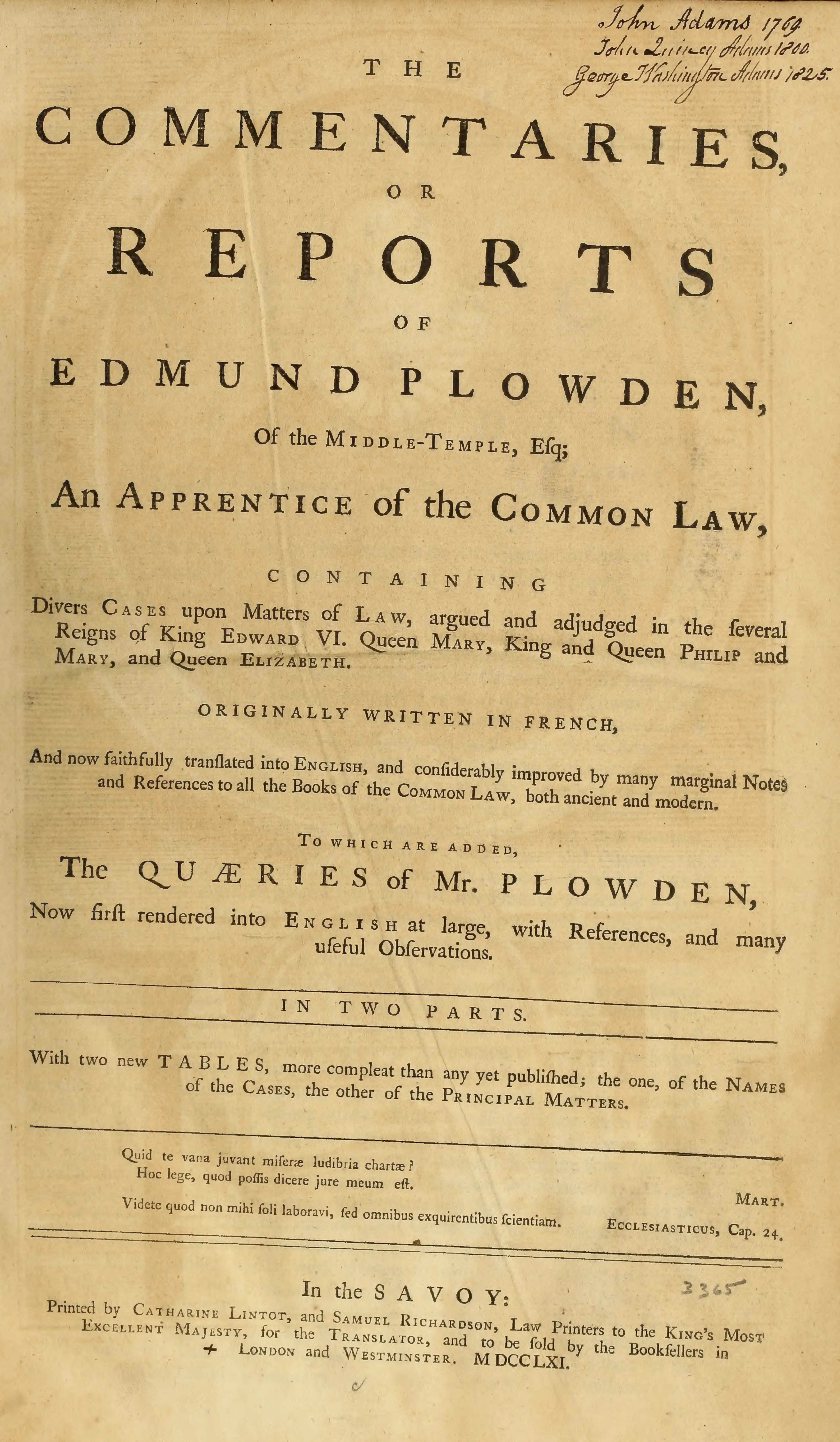
Edmund Plowden’s celebrated law reports, containing the full report of Hales v. Petit (1 Plowd. 253), the landmark case arising from the death of Sir James Hales at the Dungeon and identified as a...
The archive brings the evidence into the open. It includes historical works, maps, legal reports, and every document supplied in the 2024 title transaction. Publication here does not imply endorsement: each record states who made it, where it came from, and what it can—or cannot—establish.
A rule for reading this archive
A document proves that its maker made the recorded assertions; it does not necessarily prove those assertions. The 2024 instruments are preserved as transaction records, not presented as independent confirmation of ownership.
Edmund Plowden’s celebrated law reports, containing the full report of Hales v. Petit (1 Plowd. 253), the landmark case arising from the death of Sir James Hales at the Dungeon and identified as a...
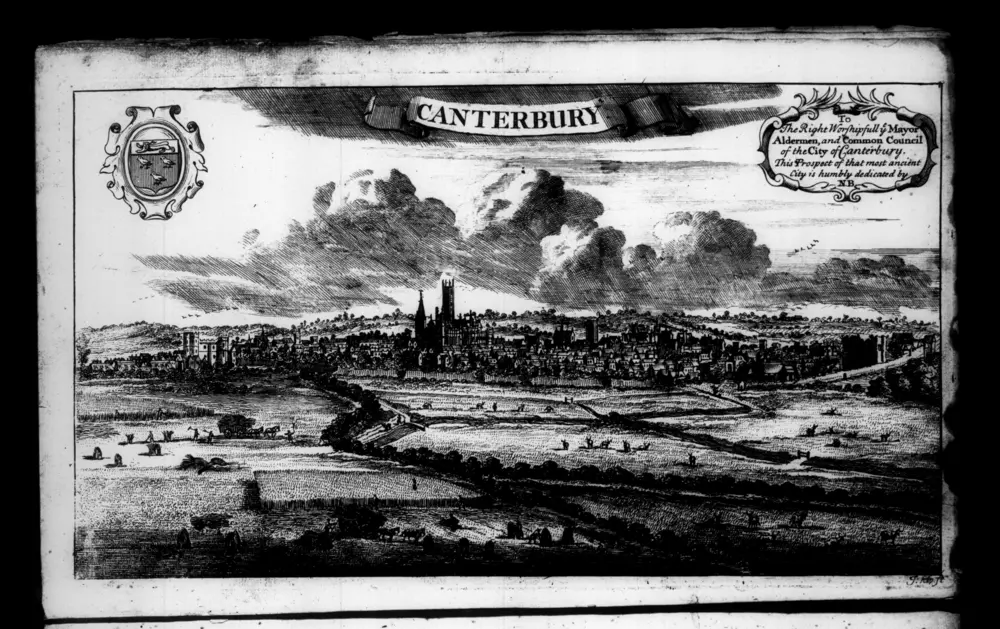
William Somner’s 1640 survey of Canterbury, the first systematic antiquarian study of the city, and the 1703 Battely edition that remains the standard scholarly reference, both drawn on by Godfrey-Faussett in his analysis of...
The arms attributed to the Hales family: Gules, three arrows Or, feathered and barbed Argent. These were personal or hereditary arms, not arms of the manor.
Edward Hasted’s survey of Kent provides the principal documented narrative of the Manor of the Dungeon from the Chiche family through Thomas Lee Warner’s demolition of the mansion in 1752.
Edward Hasted’s separate two-volume history of Canterbury, containing the passage establishing that the advowson of St. Mary Bredin descended with the Manor of the Dungeon, the key to tracing the lordship through the nineteenth...
W. H. Ireland’s county history of Kent, updating Hasted to the late 1820s and recording that the manorial estate of the Dungeon was by then ‘now known by the name of Deanjohn Farm,’ still...
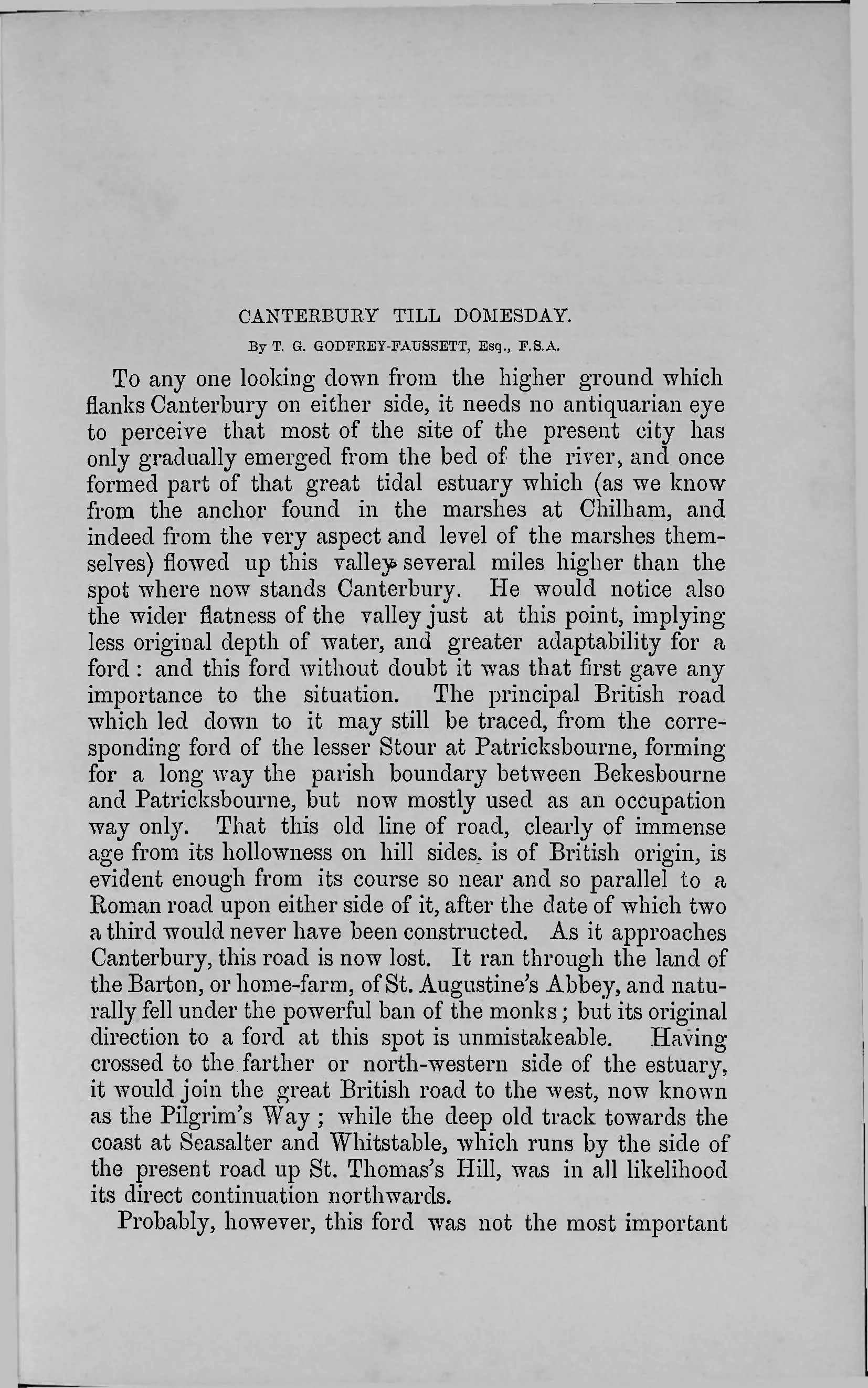
Godfrey-Faussett, T. G. “Canterbury Till Domesday.” Archaeological Journal 32, no. 1 (1875): 369-393
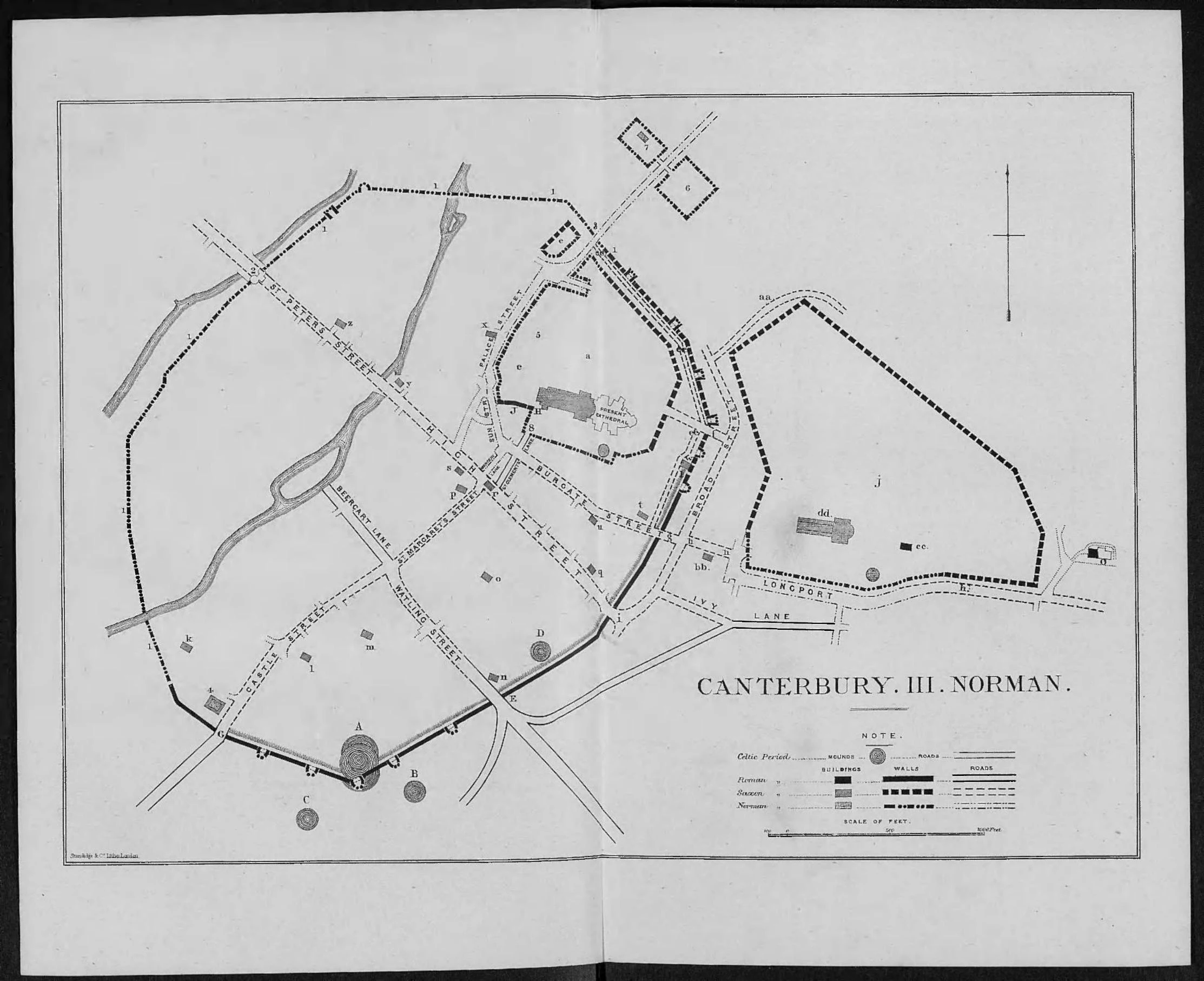
Fold-out plan of Norman Canterbury from Godfrey-Faussett’s 1875 paper, showing the westward extension of the city walls, Canterbury Castle, Archbishop Lanfranc’s palace, and other Norman additions. A nineteenth-century antiquarian reconstruction.
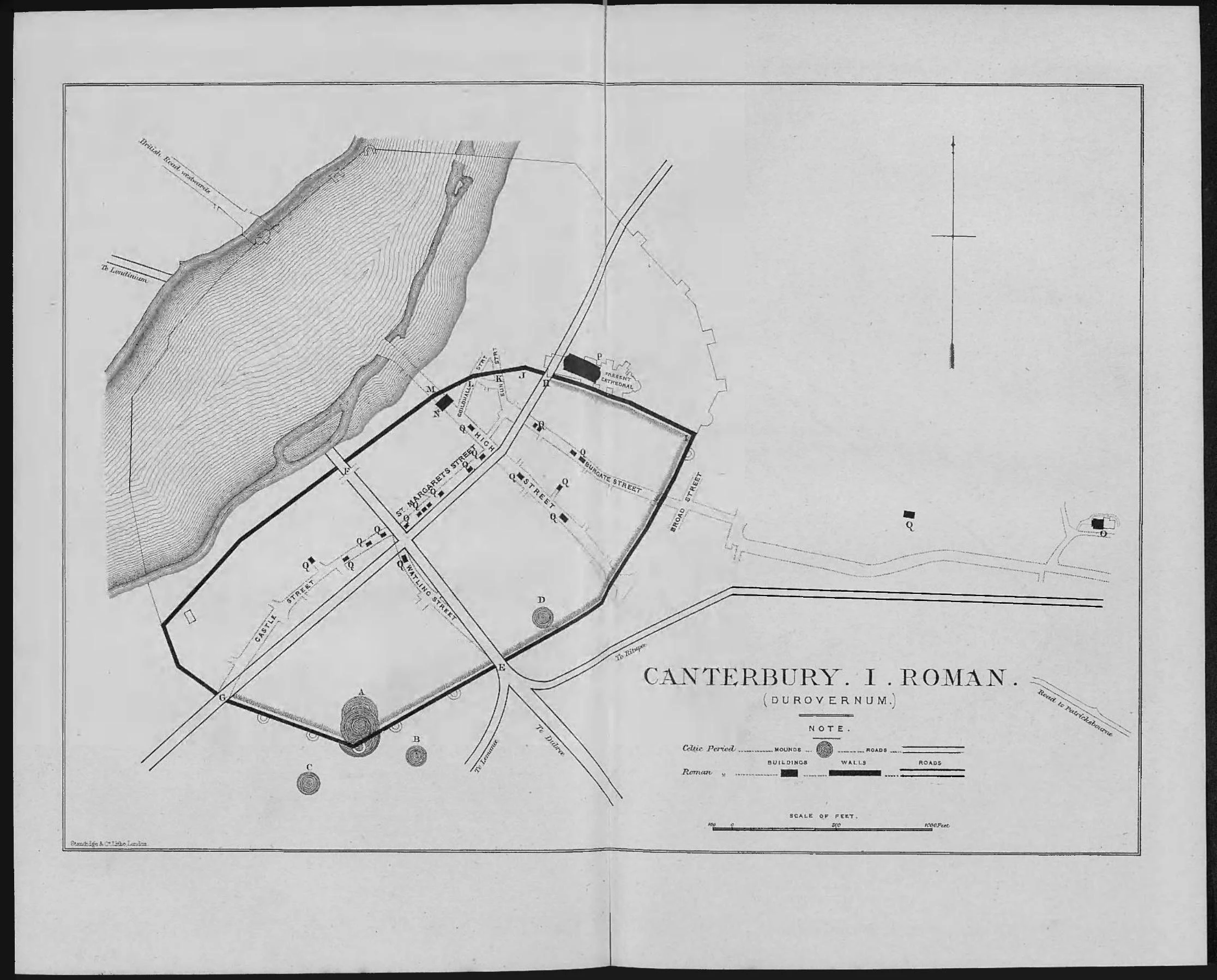
Fold-out plan of Roman Canterbury (Durovernum Cantiacorum) from Godfrey-Faussett’s 1875 paper, showing what he classified as Celtic and Roman features, with the Dane John mound at point A. A nineteenth-century antiquarian reconstruction.
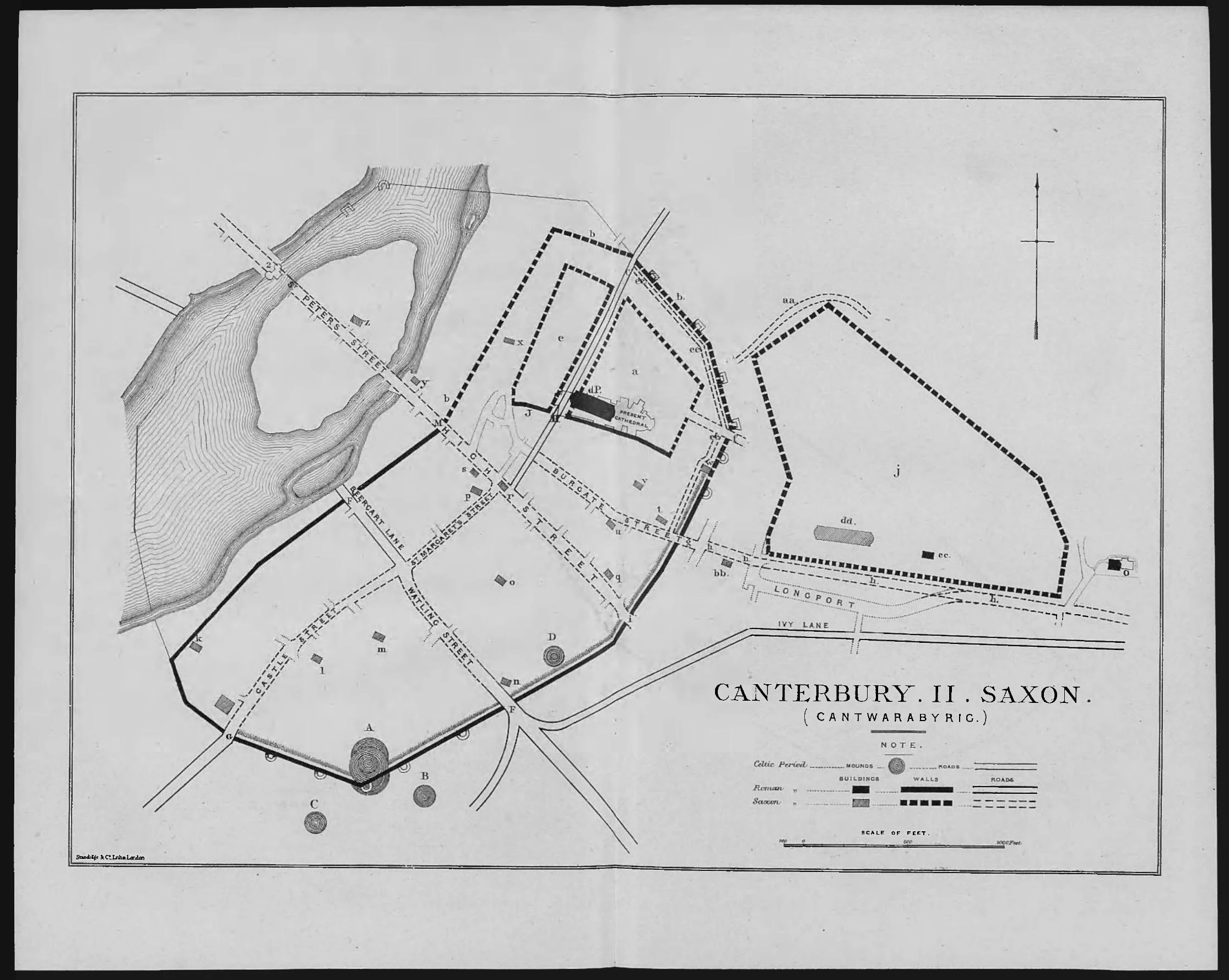
Fold-out plan of Saxon Canterbury (Cantwarabyrig) from Godfrey-Faussett’s 1875 paper, showing the northward extension of the Roman city, Ethelbert’s palace, the Saxon churches, and St. Augustine’s Abbey. A nineteenth-century antiquarian reconstruction.
John Bateman’s celebrated digest of the 1873 Return of Owners of Land, recording both branches of the Lee-Warner family, of Walsingham Abbey and of Tyberton Court, among the landowners of late Victorian Britain.
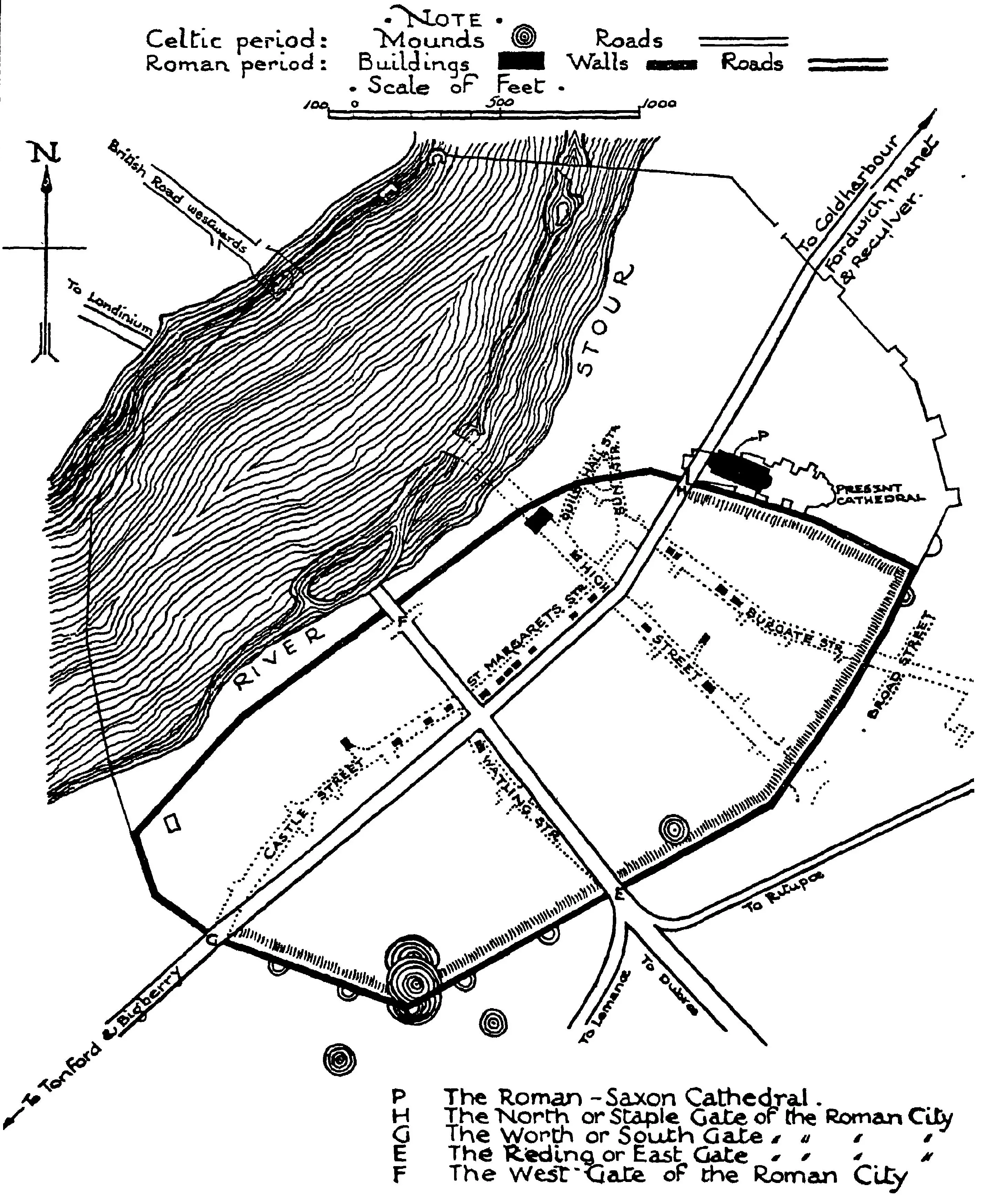
A black-and-white plan of Roman Canterbury reproduced by Charles Cotton in 1929, showing the conjectured street plan, walls, gates, public buildings, and the River Stour.
Cotton, Charles. The Saxon Cathedral at Canterbury and the Saxon Saints Buried Therein. Manchester: Manchester University Press, 1929.
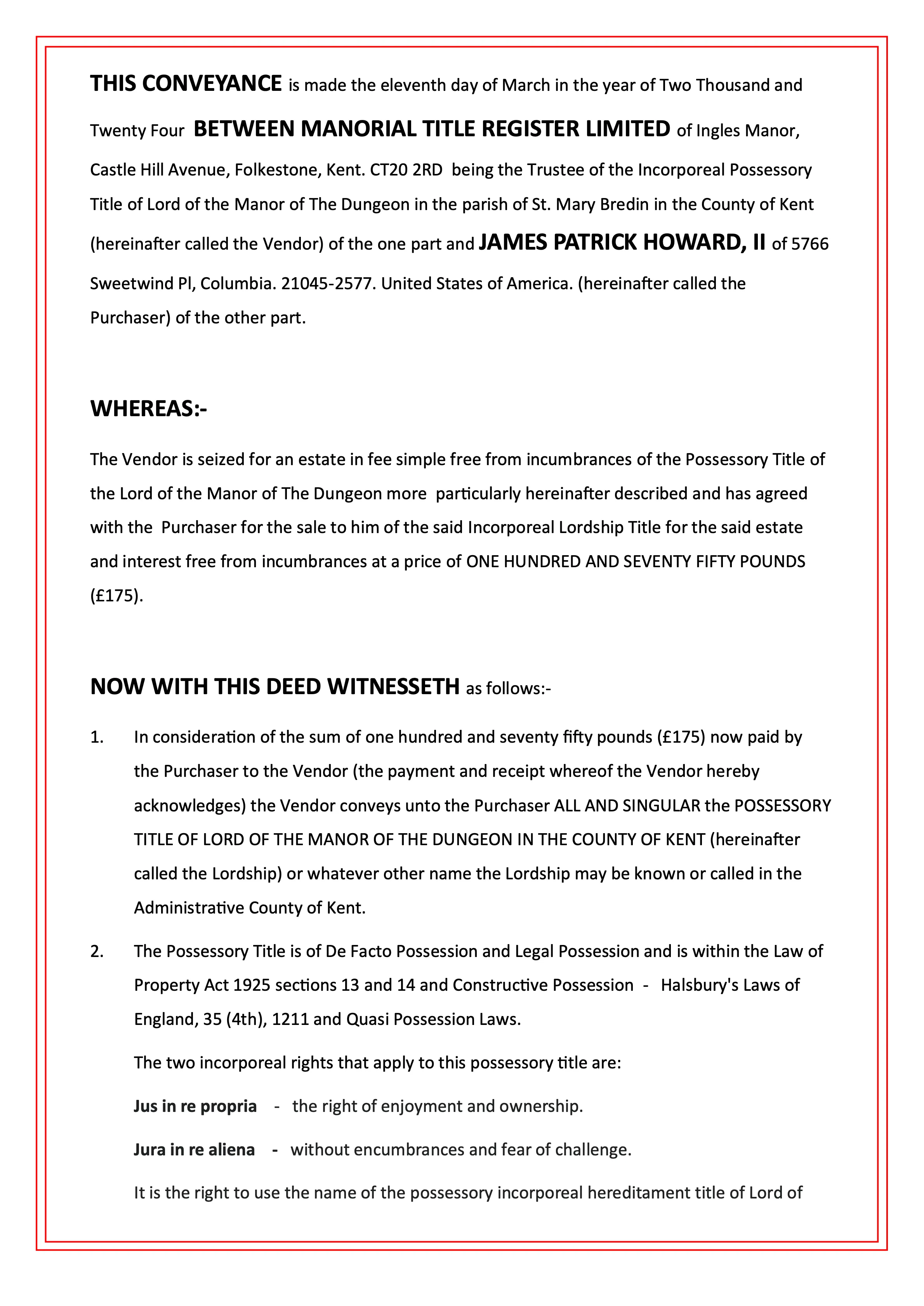
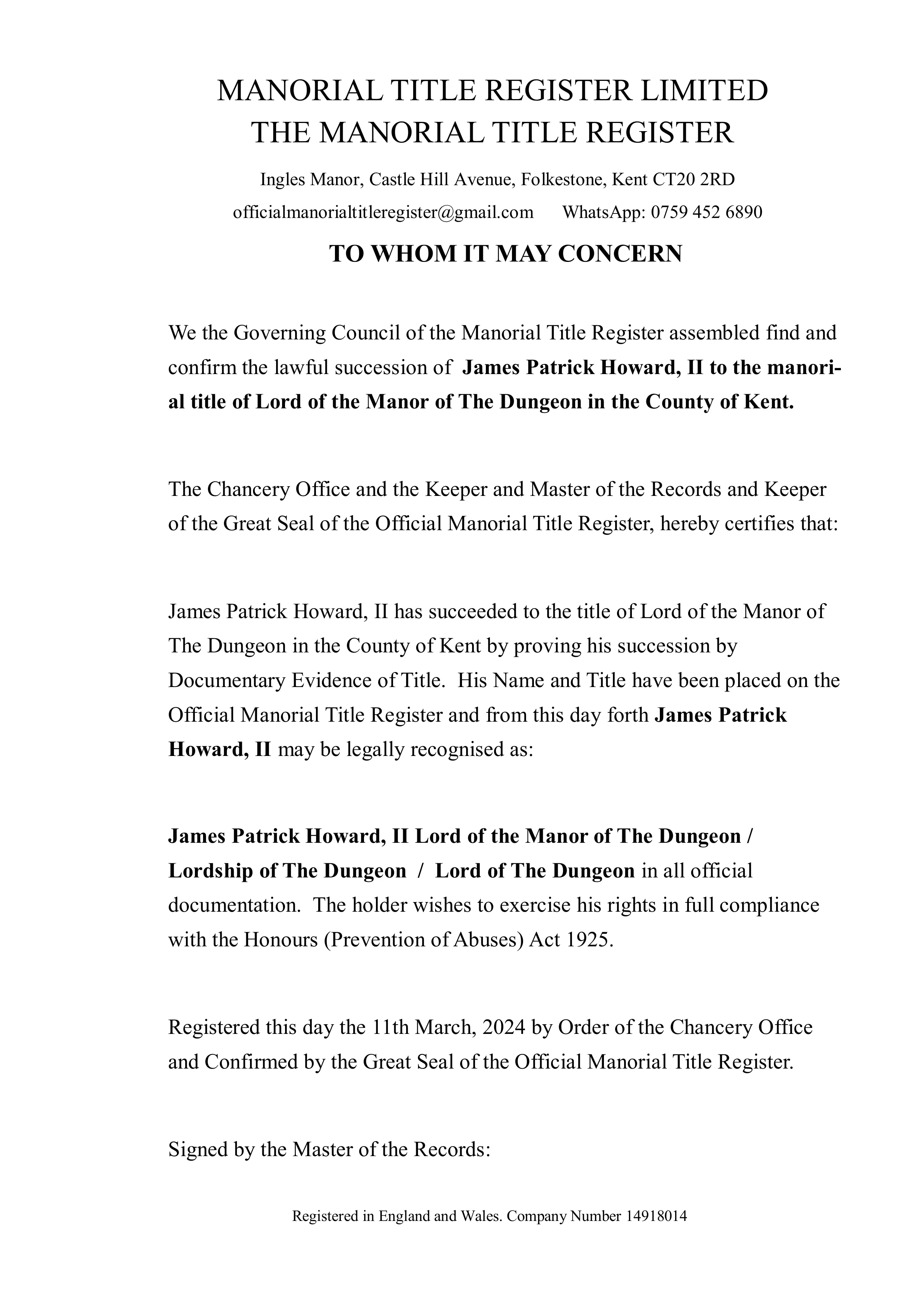
A deed dated 11 March 2024 recording Manorial Title Register Limited’s assignment to James P. Howard, II, for £175, of what the company describes as the possessory title of Lord of the Manor of...
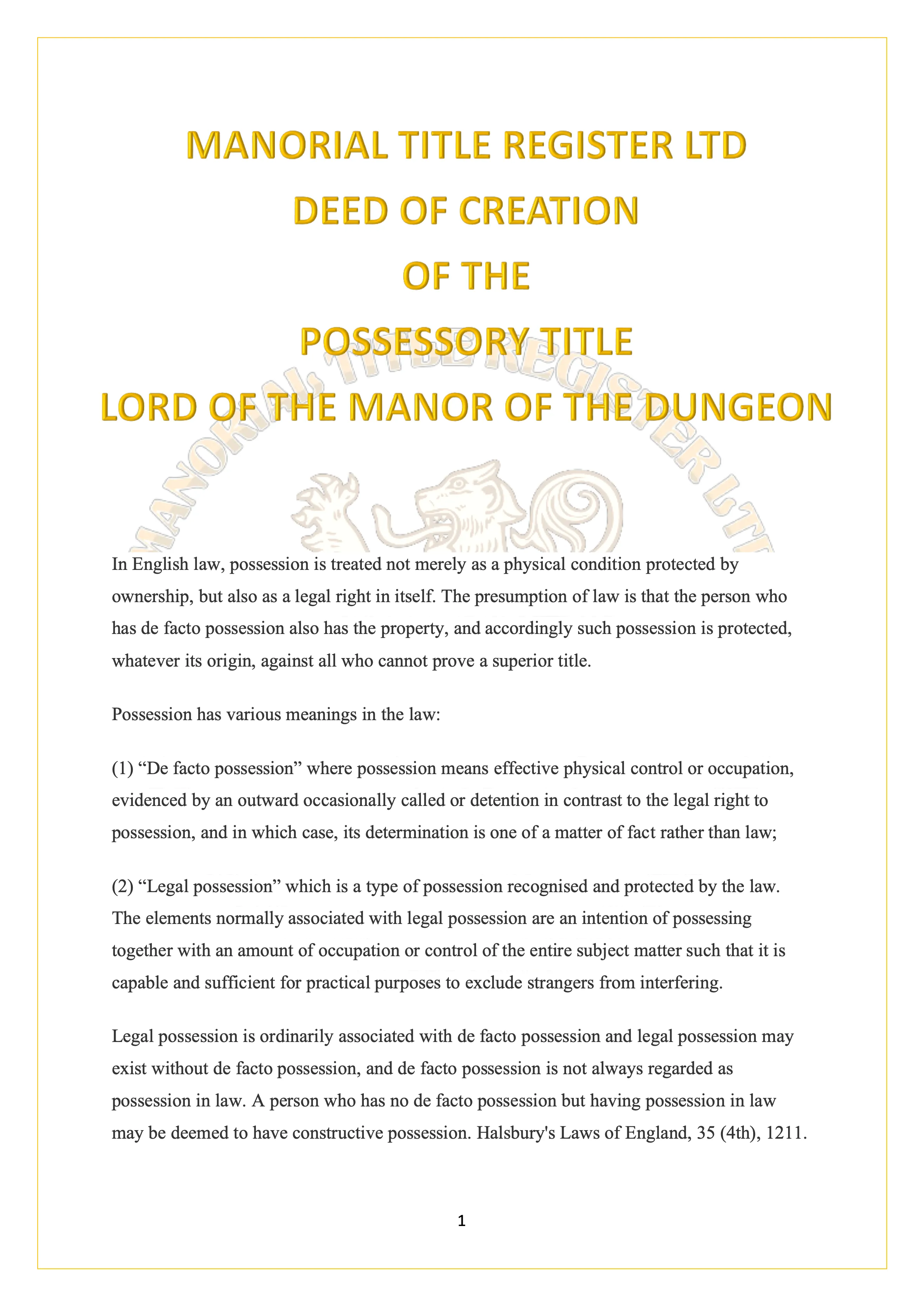
A seller-issued instrument setting out the company’s theory of a possessory manorial title and purporting to create or assign that title on 11 March 2024. It is evidence of the theory asserted, not independent...
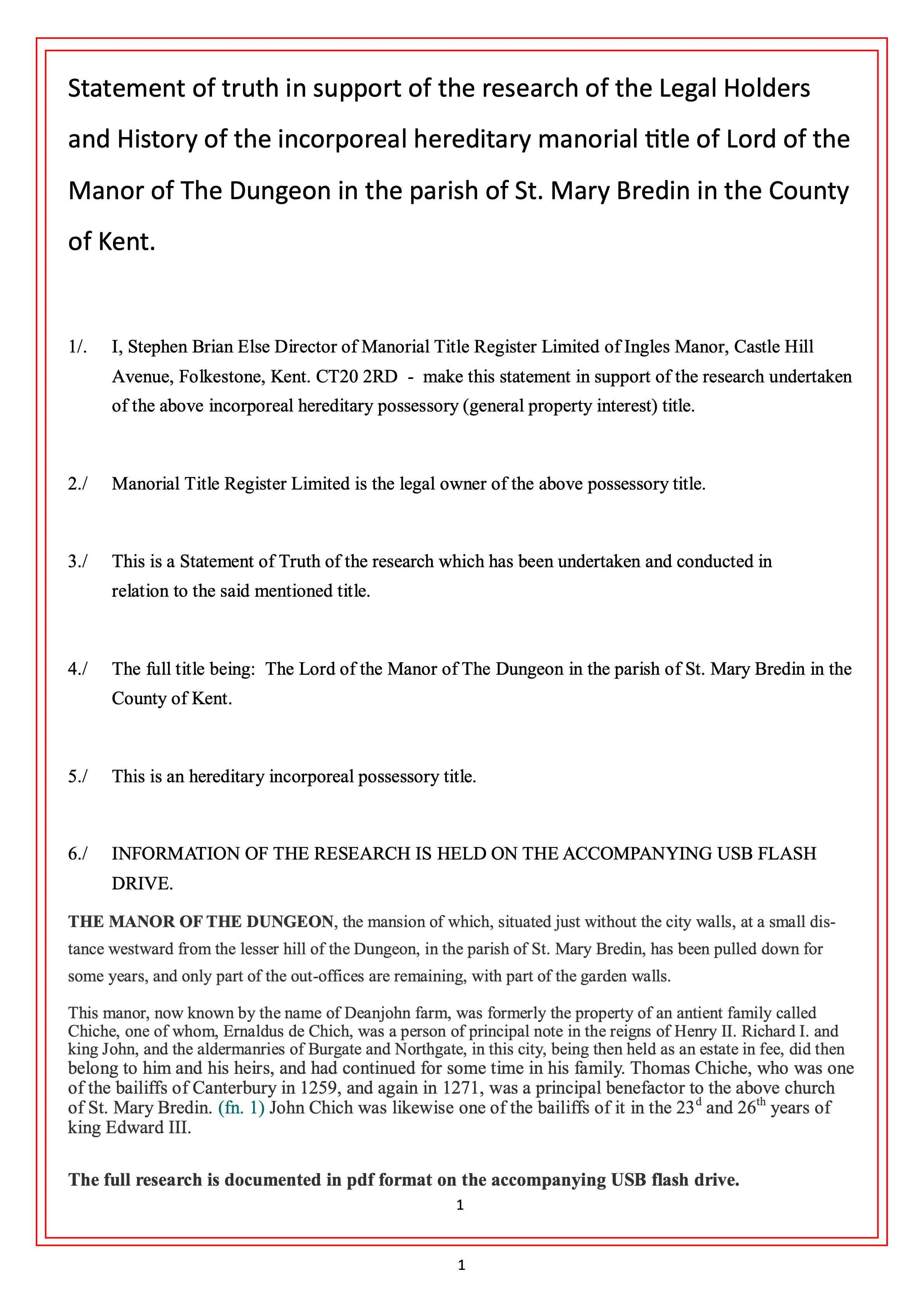
A declaration by a director of the seller asserting the company’s ownership, summarizing its historical account, and stating its belief that no living heir exists. The assertions are material but not independently corroborated within...
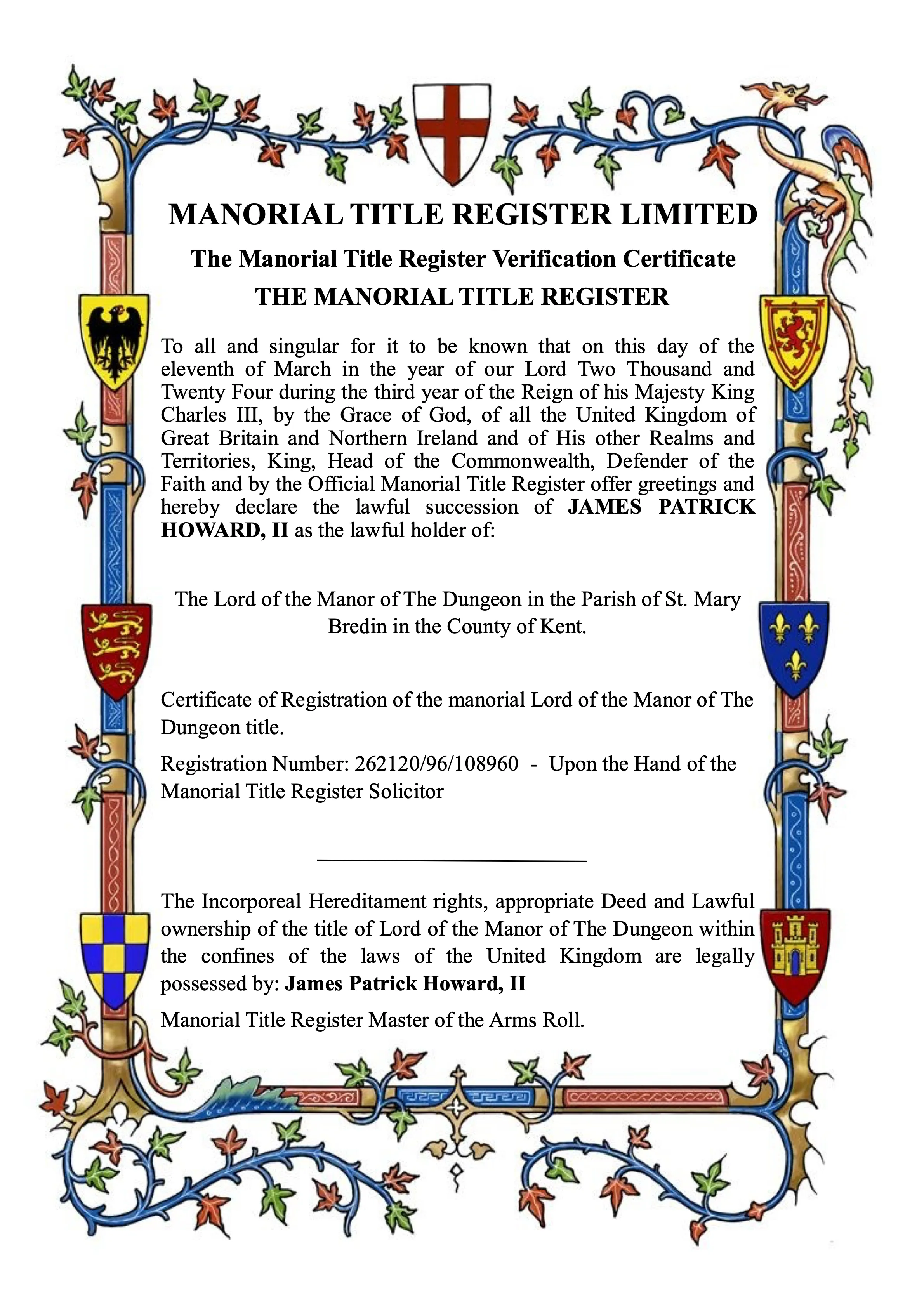
A certificate issued by Manorial Title Register Limited for its own transaction, recording James P. Howard, II, in the company’s private register. It is not a government certificate or HM Land Registry record.
A letter from Manorial Title Register Limited describing registration in its own system and the seller’s view of the title’s documentary use. It is not correspondence from a government chancery or proof of public...
Try a name, period, or broader term.
Documents, photographs, catalogue references, and corrections are welcome— especially anything bearing on the manor’s succession after 1944. Please use the contact page and include enough provenance for the material to be evaluated and cited.